On a phone screen, classical paintings often shrink into wallpaper: recognised, liked, then forgotten. Renato Basteri, a support teacher at I.C. “Alfieri Bertagnini” in Massa, Tuscany, and an artist with a background in fine arts and scenography, built VANFROG.ART to interrupt that habit. The project began in Italy in April 2026 with a deliberately simple premise. A little green frog named René, wearing blue glasses, steps into celebrated paintings to look for Julie, a shy dark-grey duckling who prefers to hide. Each day, viewers are invited to find her. The first person who does then chooses, from two proposals, which artwork will frame the next day’s game.

The mechanics sound playful, and they are. Behind them sits a more serious editorial idea about attention. In an age of endless scrolling, Basteri wants people to stop long enough to notice composition, colour and small details in works they may already think they know. AI is part of the process, but he describes it as a tool inside a directed artistic practice rather than a substitute for judgment. The original paintings remain the cultural starting point; René and Julie are the narrative devices that pull a contemporary audience back into them.
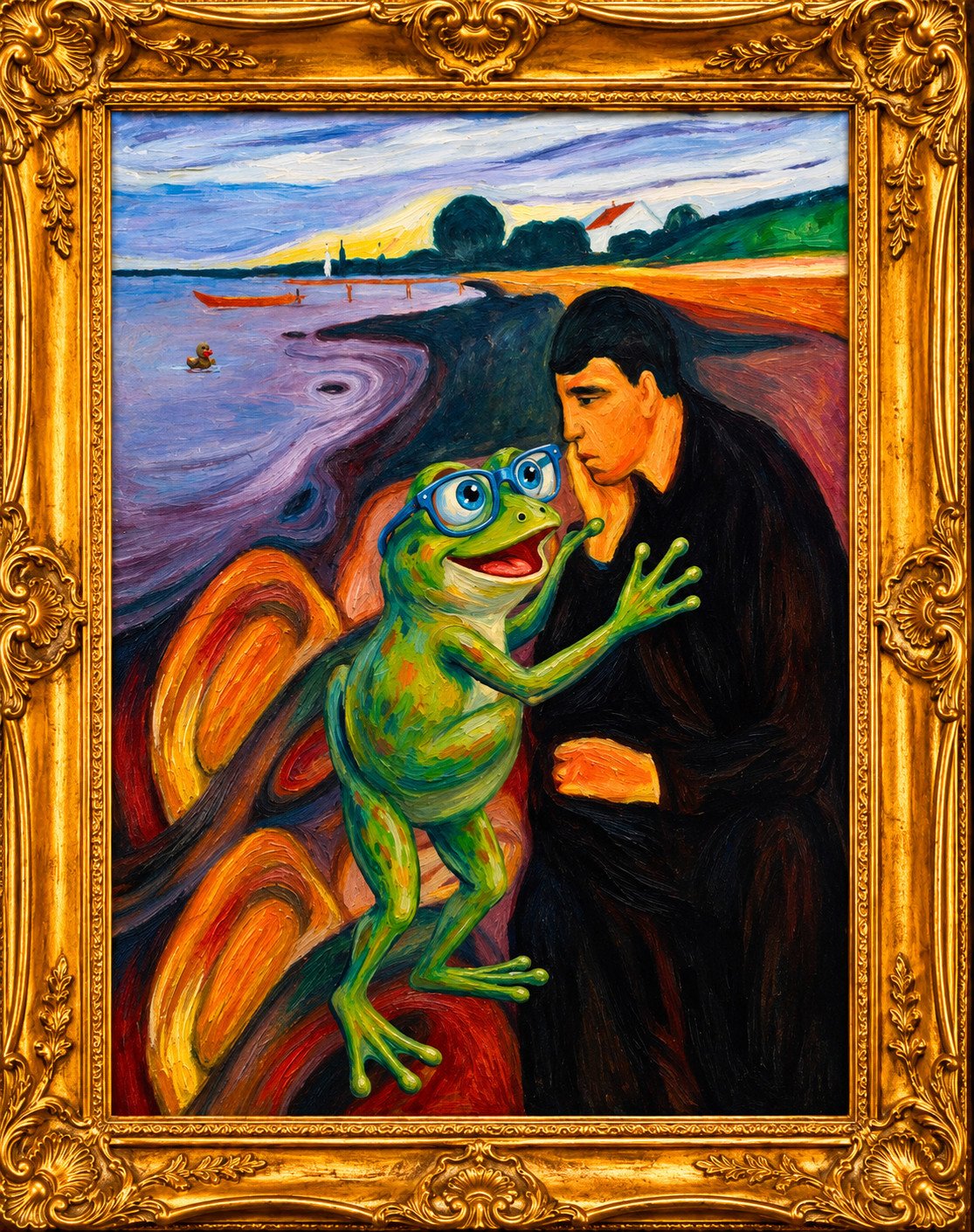
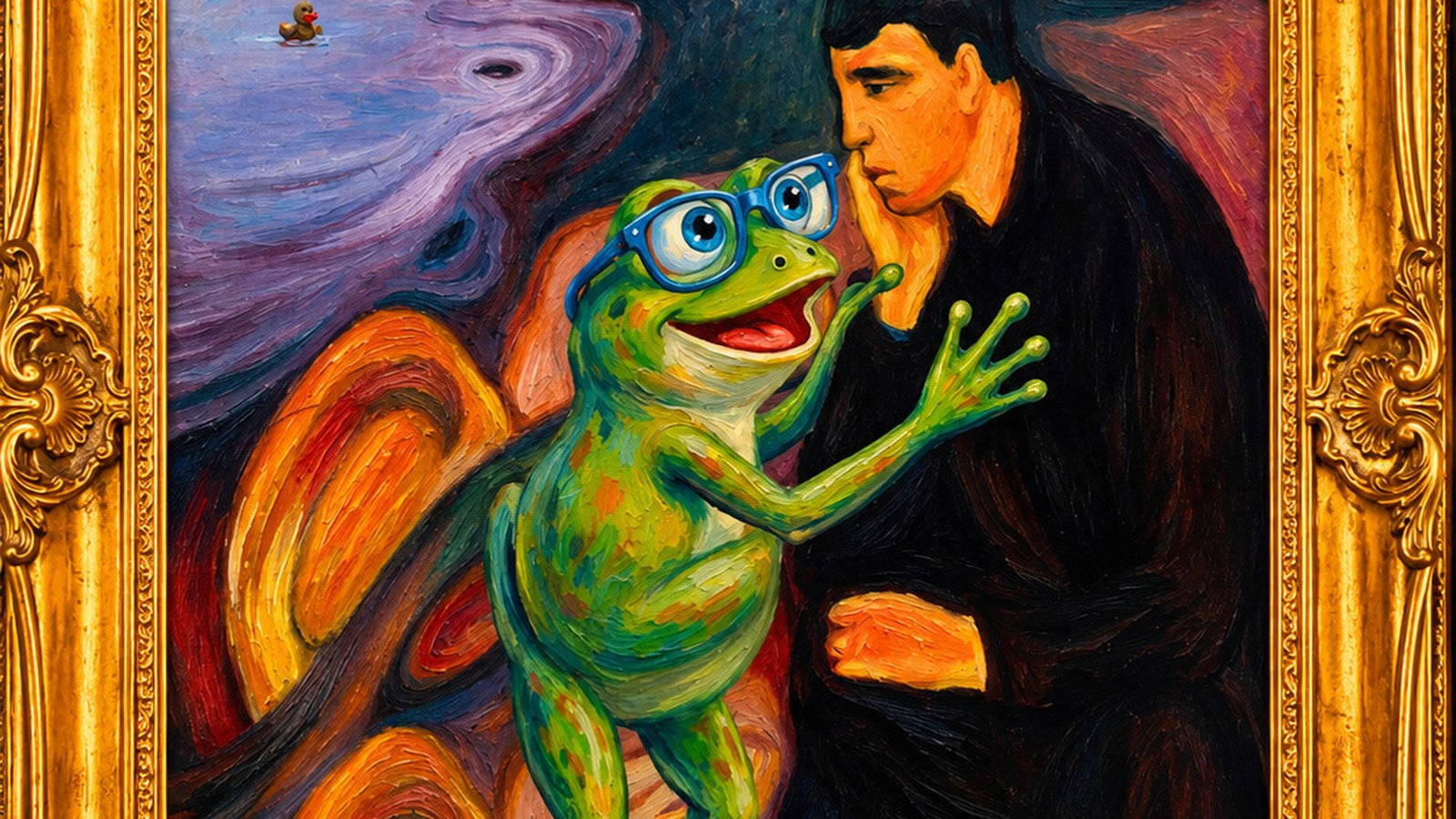
VANFROG.ART Melancholy, inspired by Edvard Munch’s Melancholy (1891). Renato Basteri — VANFROG.ART

René, Julie and the daily game


René is easy to spot once you know him: small, green, unmistakably bespectacled. Julie is the harder prize. She is meant to be found, not announced, which turns a passive scroll into an active search. According to Basteri’s account of the project, the fastest participant to locate her selects the following day’s painting from two options. The format creates a light social contract with the audience. Looking carefully becomes the entry ticket, and choosing tomorrow’s image becomes a small act of curation shared with everyone else who follows along.

That loop also explains why the project sits awkwardly — and interestingly — between categories. It is not a museum didactic panel, not a pure meme account, and not an automated image feed. It is closer to a serial game that happens to be set inside art history. Unjica has covered other projects that try to make looking itself the medium, from immersive art experiences to experiments where art and science share the same stage. VANFROG.ART belongs in that broader conversation, with a narrower wager: that a frog and a duckling can make people reopen paintings they had filed away as familiar.
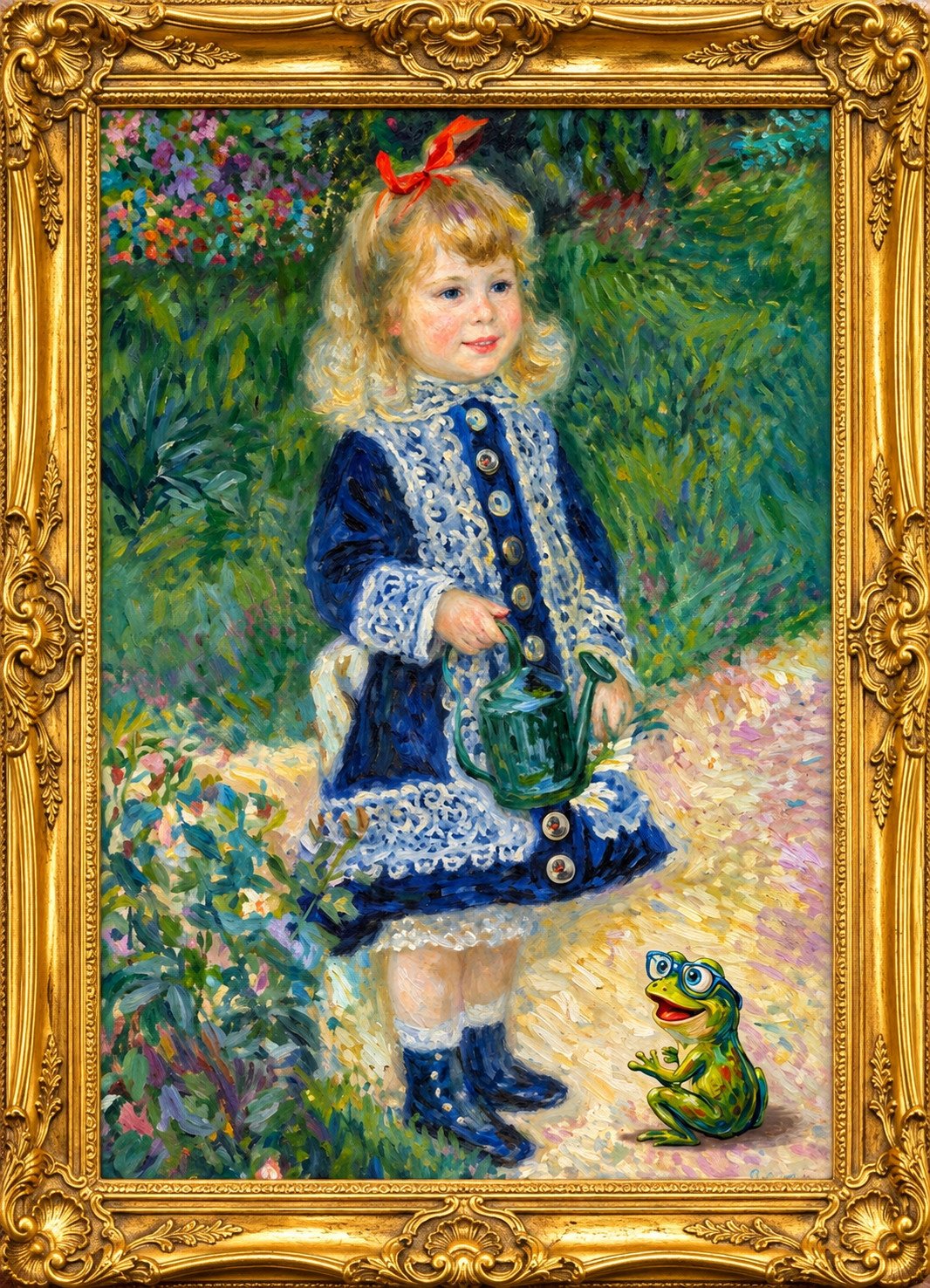
VANFROG.ART intervention inspired by Pierre-Auguste Renoir’s A Girl with a Watering Can (1876). Renato Basteri — VANFROG.ART

Classroom, classical painting and directed AI


Basteri’s day job matters to the tone of the work. As a support teacher in Tuscany, he uses AI activities with students to underline a point that also structures VANFROG.ART: artificial intelligence depends on human instructions, critical thinking and responsible use. In his framing, the model does not replace curiosity; it is subordinated to it. The same language appears when he talks about the artworks. AI assists a process he directs. The result should still be readable as an authored intervention into a known image, not as an anonymous remix without a point of view.

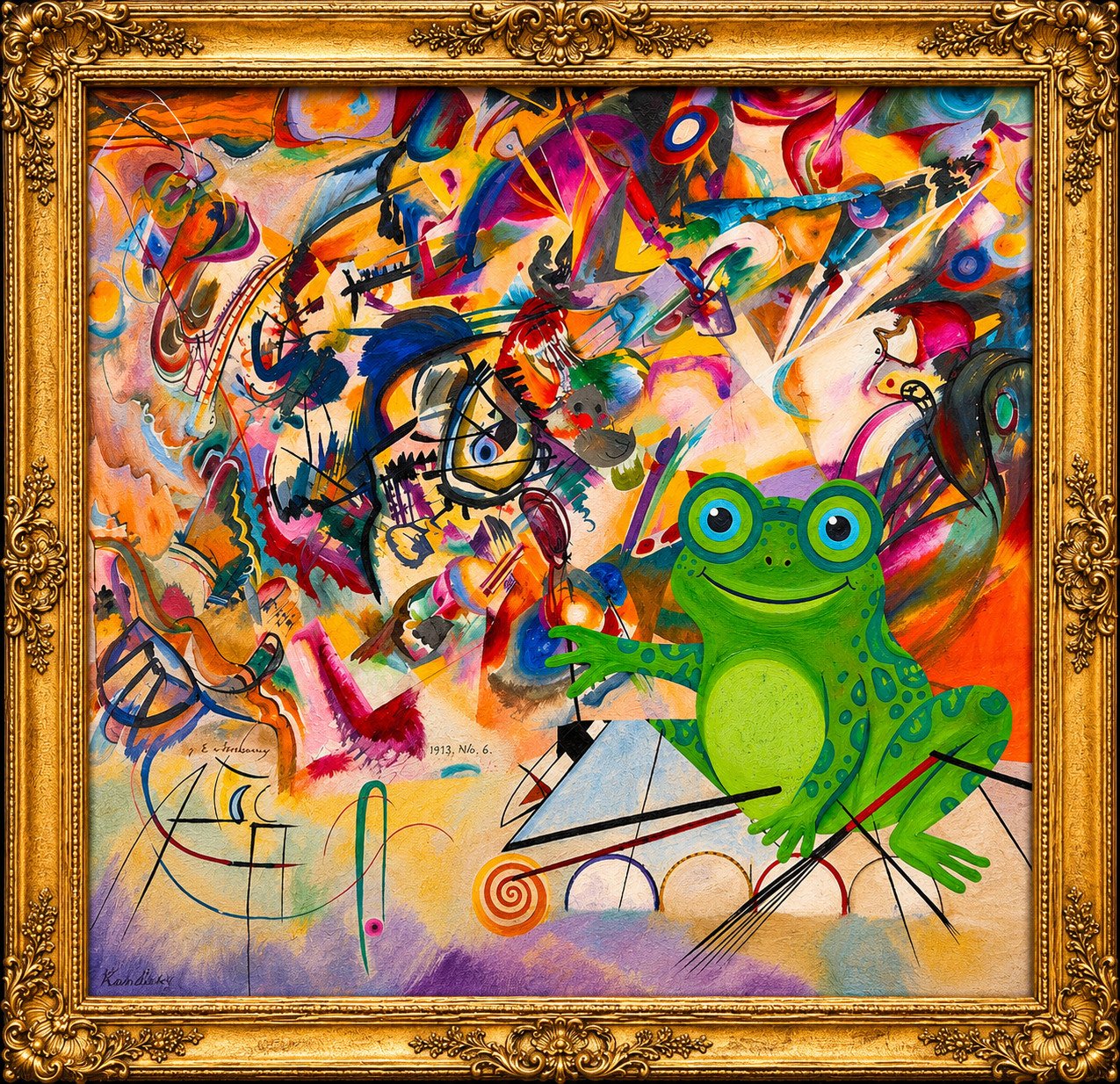
Selected pieces make that authorship visible in different keys. In a work inspired by Edvard Munch’s Melancholy (1891), René answers solitude with an embrace, turning the scene into a conversation about sadness and comfort while Julie remains hidden. In a version after Pierre-Auguste Renoir’s A Girl with a Watering Can (1876), the frog enters a garden encounter that feels almost conversational. A piece after Henri Rousseau’s The Sleeping Gypsy (1897) lets René drift into a nocturnal landscape. Another, after Wassily Kandinsky’s Composition VI (1913), nearly dissolves him into abstract rhythm, as if the search had moved from figure to pure form.
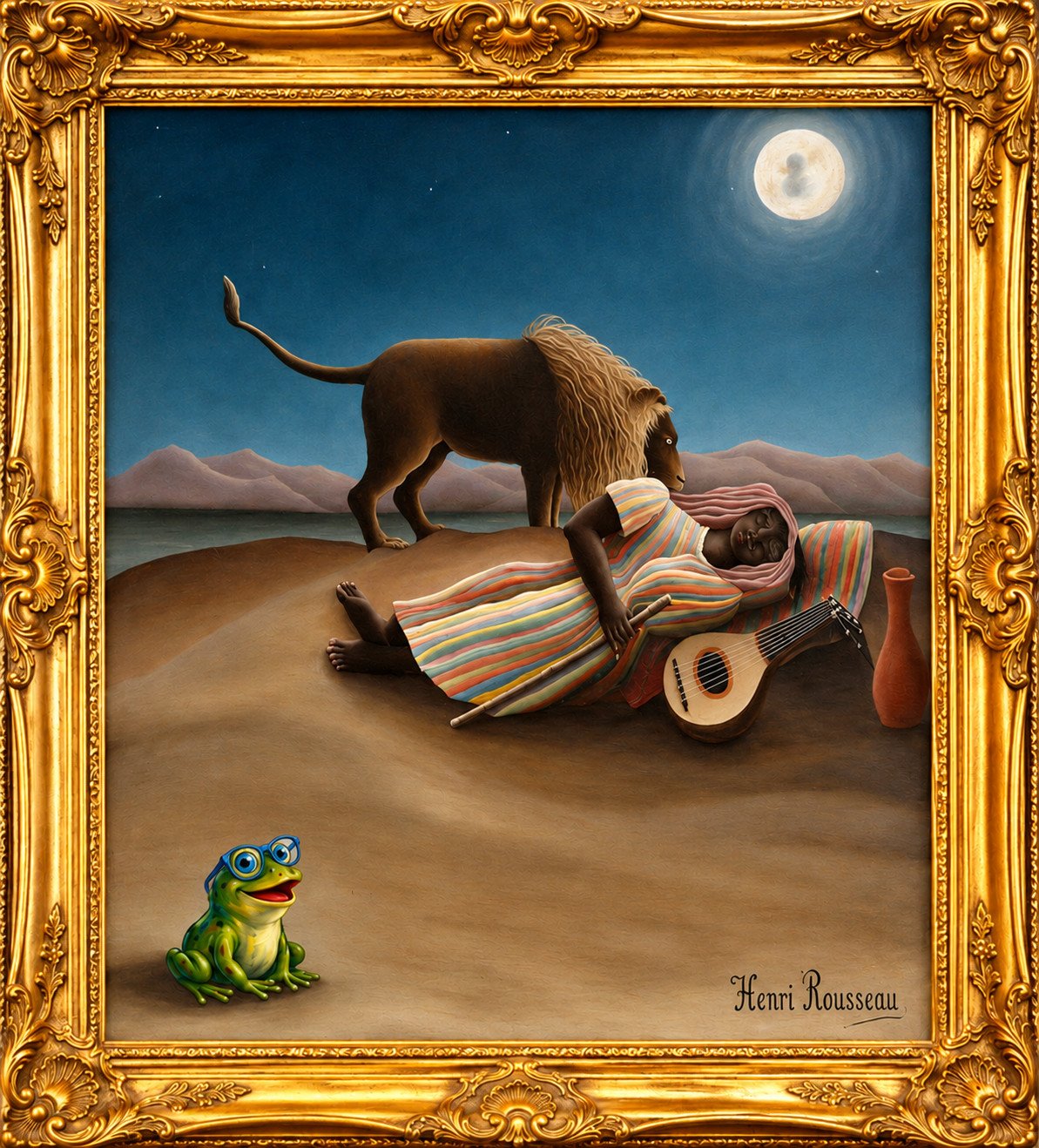
VANFROG.ART work inspired by Henri Rousseau’s The Sleeping Gypsy (1897). Renato Basteri — VANFROG.ART
René inside abstract colour in a VANFROG.ART work after Wassily Kandinsky’s Composition VI (1913). Renato Basteri — VANFROG.ART
These examples are useful because they refuse a single gag. Empathy, play, silence and abstraction all appear. The constant is the invitation to look again. That is also why the project’s relationship to classical art is less about spoofing masterpieces than about reopening them. Artists and educators have long argued that familiarity can be a form of blindness. Basteri’s answer is narrative pressure: if Julie might be anywhere in the frame, the whole surface becomes active.

Readers curious about how artists extend a painting beyond a unique canvas may also recognise a practical cousin in print and reproduction culture, including guides such as Unjica’s note on selling art as prints online. VANFROG.ART takes a different route — daily interaction rather than edition sales — but it shares the same problem of keeping a still image alive in a networked present.

From phone screen to book and public screens


The project did not stay only on Instagram. An illustrated bilingual book, titled in English Where Is the Shy Duckling Hiding? Find It in the Paintings, translates the search into a printed sequence of looking and discovery. The cover presents the game as something you can hold, not only swipe. That move matters editorially: it suggests Basteri is testing whether the same attentive habit can survive offline, where there is no algorithm refreshing the feed.
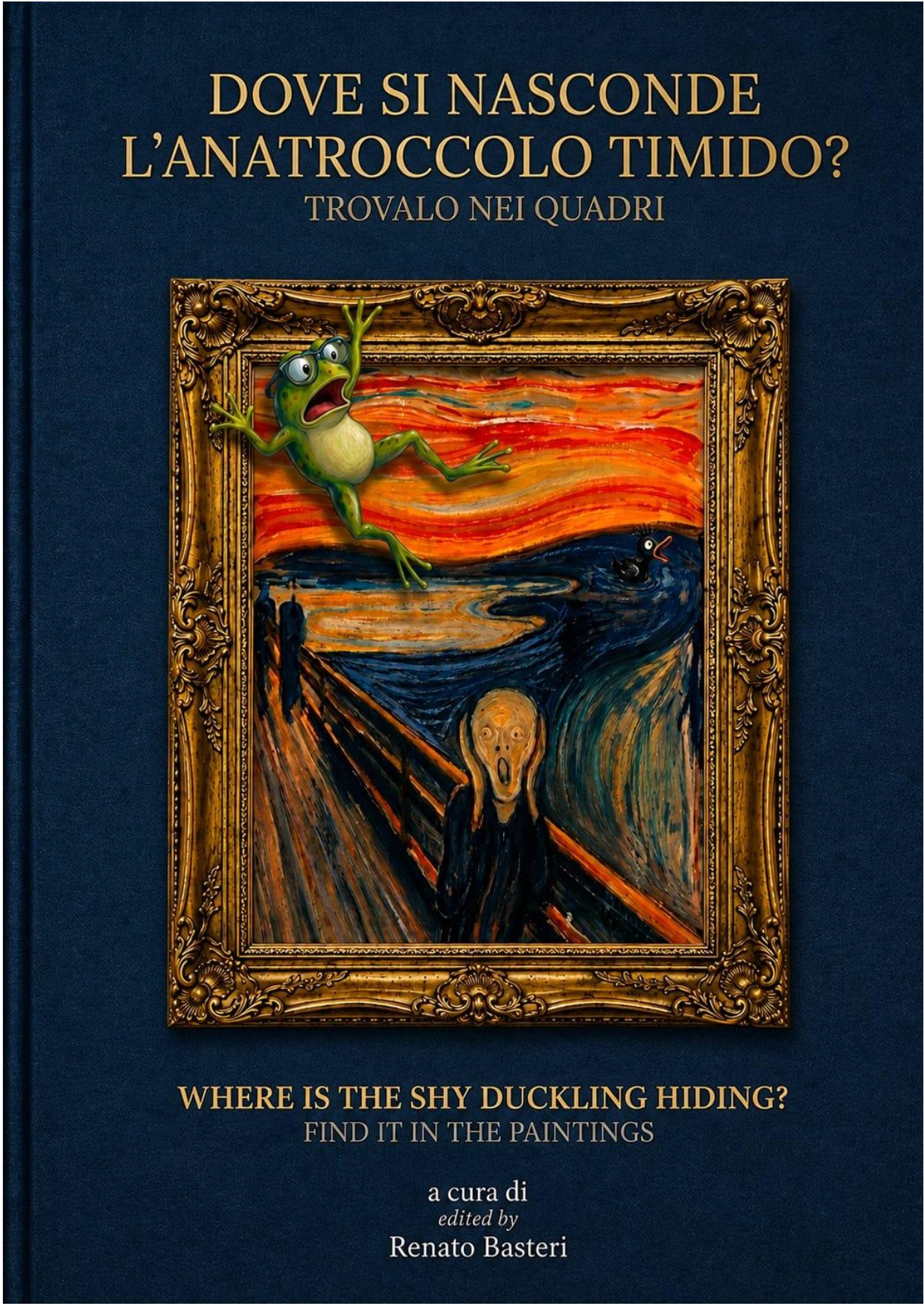
Cover of Renato Basteri’s bilingual illustrated book Where Is the Shy Duckling Hiding? Find It in the Paintings. Renato Basteri — VANFROG.ART
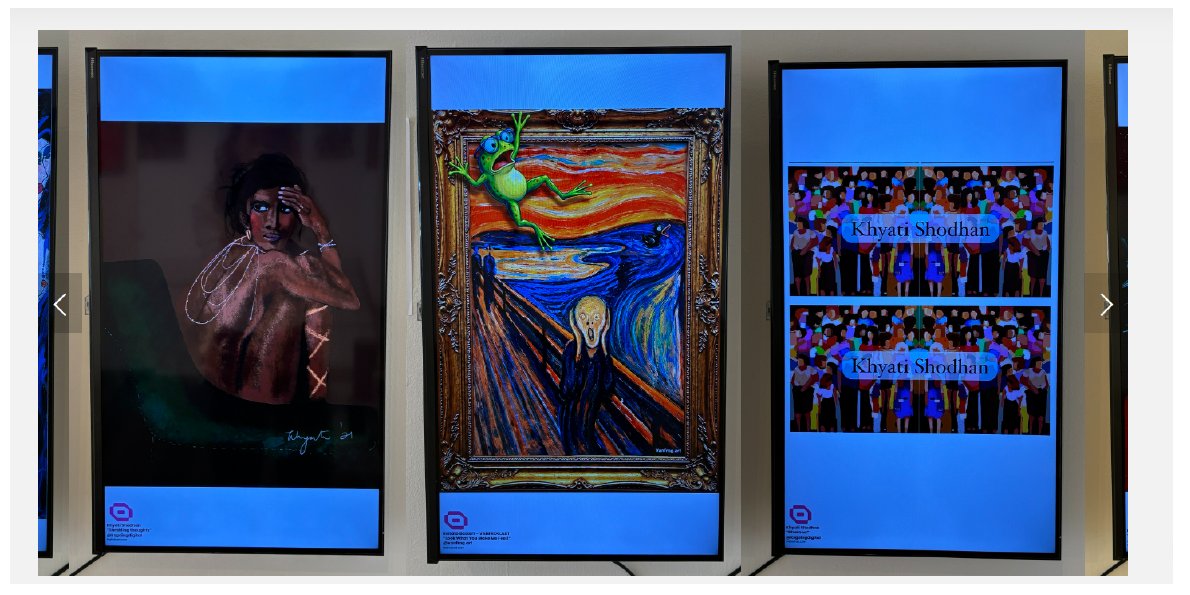
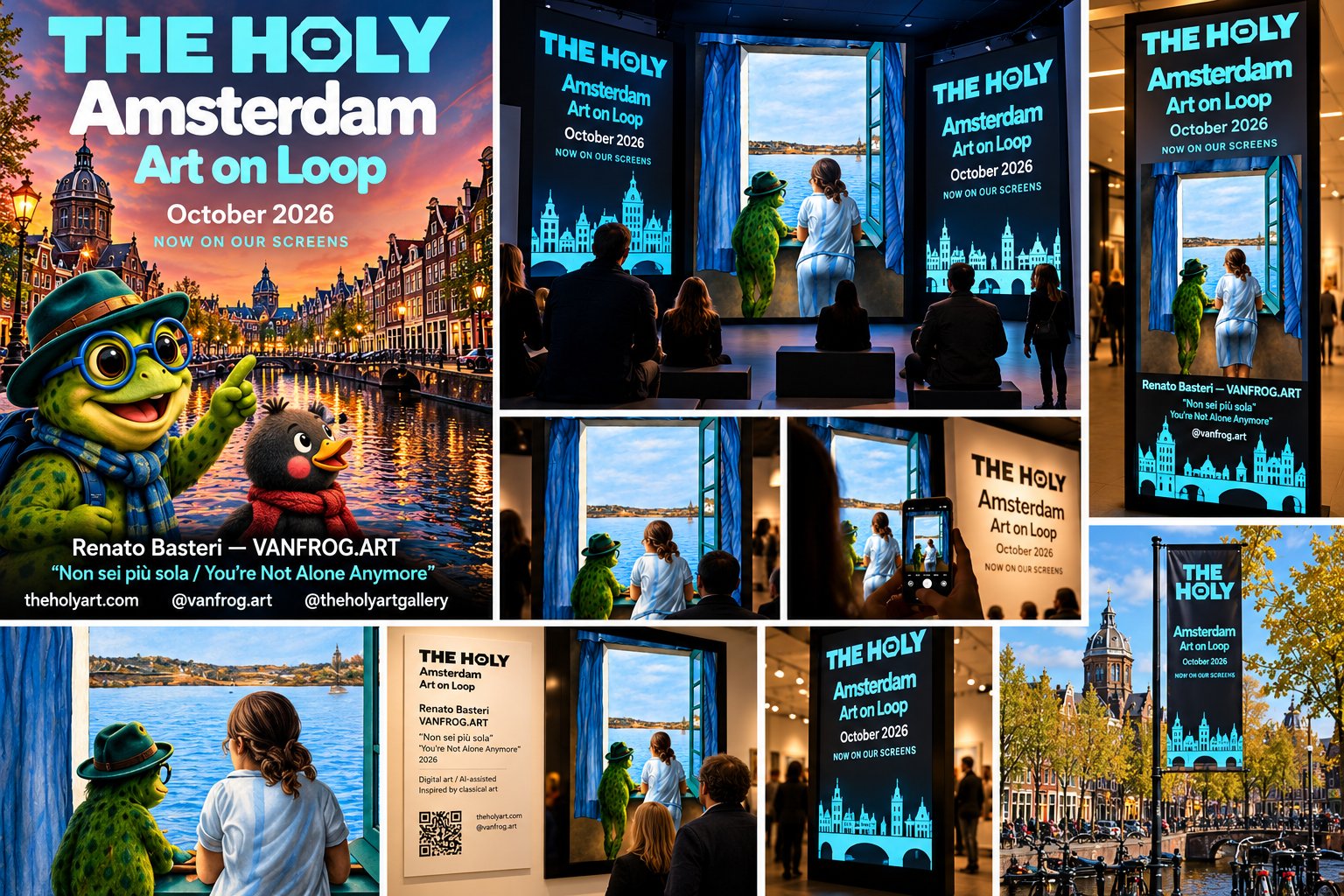
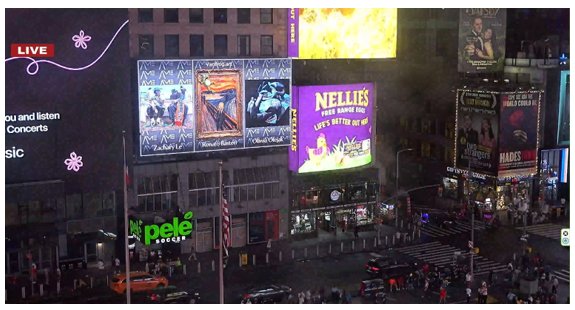
Public presentations have followed a similar logic of carrying the images into shared spaces, with important distinctions of format. On 12 June 2026, VANFROG.ART appeared as a digital projection in New York’s Times Square. In Milan in 2026, documentation shows Basteri standing beside a presentation of Look What You Make Me Feel!, a work inspired by Munch’s The Scream. From 6 to 9 October 2026, the project was presented digitally in Harajuku, Tokyo, with The Holy Art as part of Tokyo Open Art. Between 30 October and 2 November 2026, it was presented at Amsterdam’s Art on Loop exhibition. Basteri has also mentioned further appearances scheduled for Madrid in November 2026 and Paris in January 2027. Those later dates are plans, not yet documented outcomes in the materials reviewed for this feature.

Digital projection of VANFROG.ART in Times Square, New York, 12 June 2026. Renato Basteri — VANFROG.ART
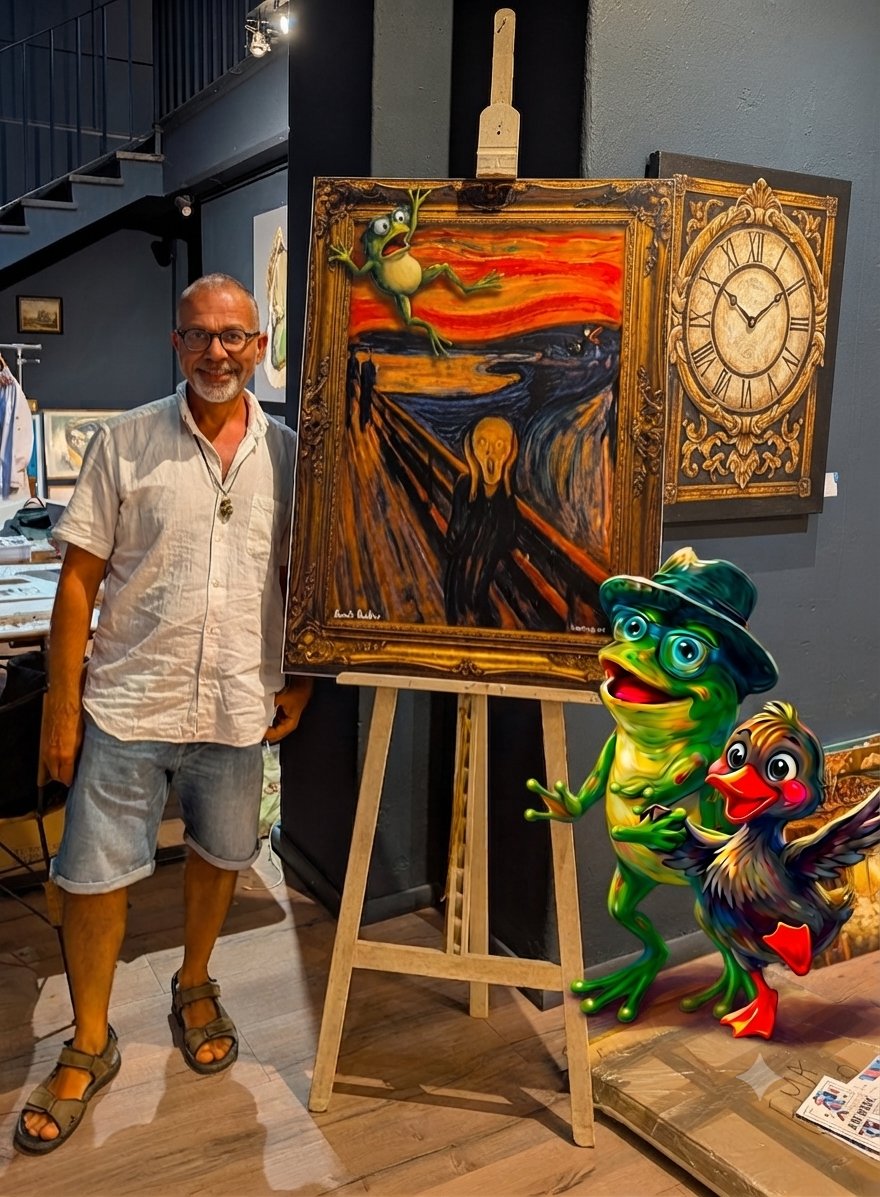
Renato Basteri with a VANFROG.ART presentation in Milan, 2026. Renato Basteri — VANFROG.ART
VANFROG.ART presented digitally at Tokyo Open Art in Harajuku, 6–9 October 2026. Renato Basteri — VANFROG.ART
VANFROG.ART at Amsterdam Art on Loop, 30 October–2 November 2026. Renato Basteri — VANFROG.ART
By 3 November 2026, Basteri reported that the @vanfrog.art Instagram account had more than 8,400 followers and more than 163,000 views over the preceding 30 days. Numbers like those are snapshots, not proof of quality, but they do show that a local Italian experiment found an international audience quickly. What travels, on the evidence of the works themselves, is less a claim about AI novelty than a repeatable reason to look: find the duckling, notice the painting, decide what comes next.

VANFROG.ART remains early. It began only in April 2026, and its public path is still opening. For Unjica’s readers, the interest is not that a frog entered the museum postcard. It is that Basteri’s mix of teaching, storytelling and carefully bounded AI treats classical painting as something that can still demand time — one search for Julie at a time.