Museum
Eric Joyner’s Looking Sideways: Robots, Donuts, and Pop Surrealism
Eric Joyner’s Looking Sideways at Corey Helford Gallery (July–August 2025) used robots and donuts as stand-ins for human longing amid AI-era anxiety.
By Unjica Editorial
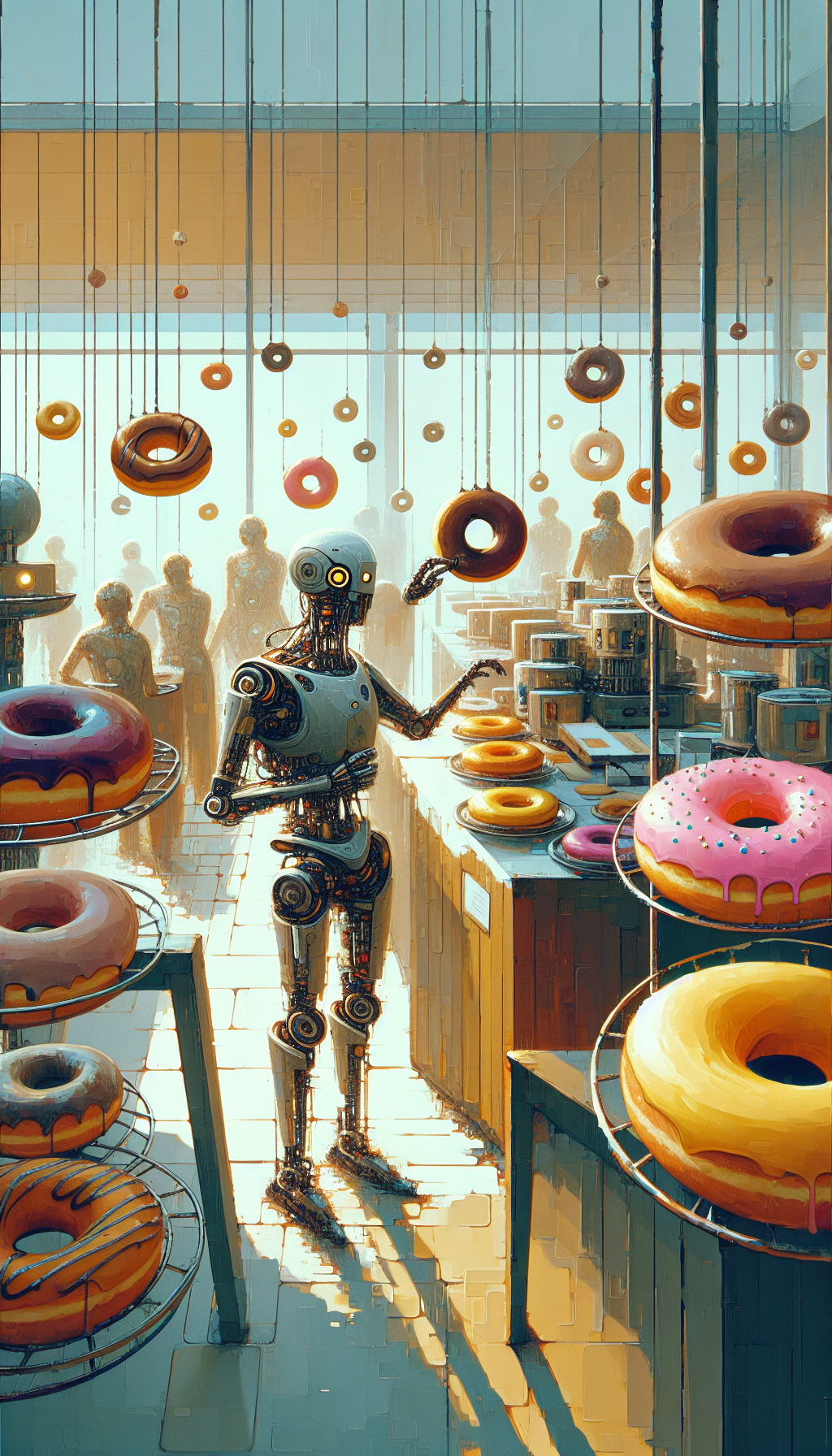
Painter Eric Joyner’s solo exhibition **Looking Sideways** at Corey Helford Gallery (July–August 2025) extended a practice long populated by toy robots and floating donuts—motifs he treats as stand-ins for human longing rather than mere kitsch, *My Modern Met* reported.
Joyner kept toy robots on his shelves while studying at the Academy of Art in San Francisco, but only began painting them in earnest after a decade as an illustrator. He was drawn to their angular silhouettes and tin color ranges, then pushed further. “I was at first compelled by a strong desire to understand human behavior and the role that conflict plays in all life,” he told *My Modern Met*. “For me, intelligent life is the most interesting subject and by expressing this importance by means of bringing inanimate objects to life, hopefully people can escape themselves for a few moments and see things differently.”
Scenes in the show ranged from robots buying ice cream and snapping selfies in bed to machines watching Godzilla and King Kong clash across a desert. Donuts arrive as absurd counterparts. “On the surface, robots and donuts placed together for any reason seems absurd—and is,” Joyner said. “I’m just holding a mirror to humanity. We are here and don’t know why.” In **Matinee**, robots attend a screening of *2001: A Space Odyssey* while oversized donuts tumble from the sky. Mid-century modeling and Hopper-like architecture keep settings familiar until scale and absurdity interrupt.
Joyner named **Moment of Truth**—a robot parent watching a child survey a bakery case—as his favorite canvas in the exhibition: “I wanted to capture the moment when a child makes his first visit to a bakery.” Other titles circulating with the show included **The Scrollers**, **Someday World**, **Baker’s Nightmare**, **Ice Cream Shop**, and **New Frontier**. Of the paired motifs he added: “The robots fumble toward something human, mirroring our own attempts to find meaning in a world growing increasingly fragmented. Donuts appear as both coping mechanisms and existential props: absurd, sweet, and fleeting, much like the comforts we cling to in the face of uncertainty.”
He situates the humor against AI-era anxiety without abandoning buoyancy: “As we teeter on the edge of a murky future shaped by artificial intelligence, these paintings become reflections of our collective anxieties and quiet hopes,” Joyner said. Looking Sideways argued that even in a world of circuits, the desire for tenderness—and a donut—remains recognizable.
modern artart digestmuseum
About the author
Unjica Editorial
Curated art news and analysis from the Unjica editorial team.
Reader response
Comments (0)
Share your thoughts on this piece. Thoughtful, art-focused discussion is welcome.
A
No comments yet. Be the first to respond to this artwork.